Cattle first, sheep where it counts
Most stock fencing around Tamworth is cattle fencing. Beef cattle farming is the largest employing industry on the Liverpool Plains, with 175 people at the 2021 Census (ABS QuickStats, Liverpool Plains), and it accounted for one job in five in Walcha (ABS QuickStats, Walcha). Sheep matter too, especially on the tablelands, where a sheep fence is usually a dog fence as well.
The difference shows up in the specification. Cattle need a fence they respect and cannot push over. Sheep and goats need one they cannot get through or under. A paddock that might carry either over its life needs to be fenced for the harder of the two.
What contractors usually quote
| Fence | Suits | Points to settle |
|---|---|---|
| Plain wire with a barbed top | Quiet cattle on internal and boundary fences | How many wires, how far apart, how they are tensioned |
| Barbed wire, several strands | Cattle boundaries, road frontages, bulls | Neighbours with horses may object. Agree it first. |
| Netting with plain or barbed above | Sheep, goats, lambs and mixed stock | Netting height and grade, and what holds the bottom down |
| Any of the above with electric offsets | Cattle that lean, and dog or pig country | Energiser size, earthing, who keeps it working |
Netting is sold in grades that look alike. One manufacturer's data sheet lists mild steel, light high tensile and high tensile versions of the same hinge joint netting, with different wire diameters in each (one manufacturer's data sheet). That is one maker's range, not a requirement. It is enough to show why a quote should name the product and grade instead of just saying "ringlock".
Black soil and hard ground
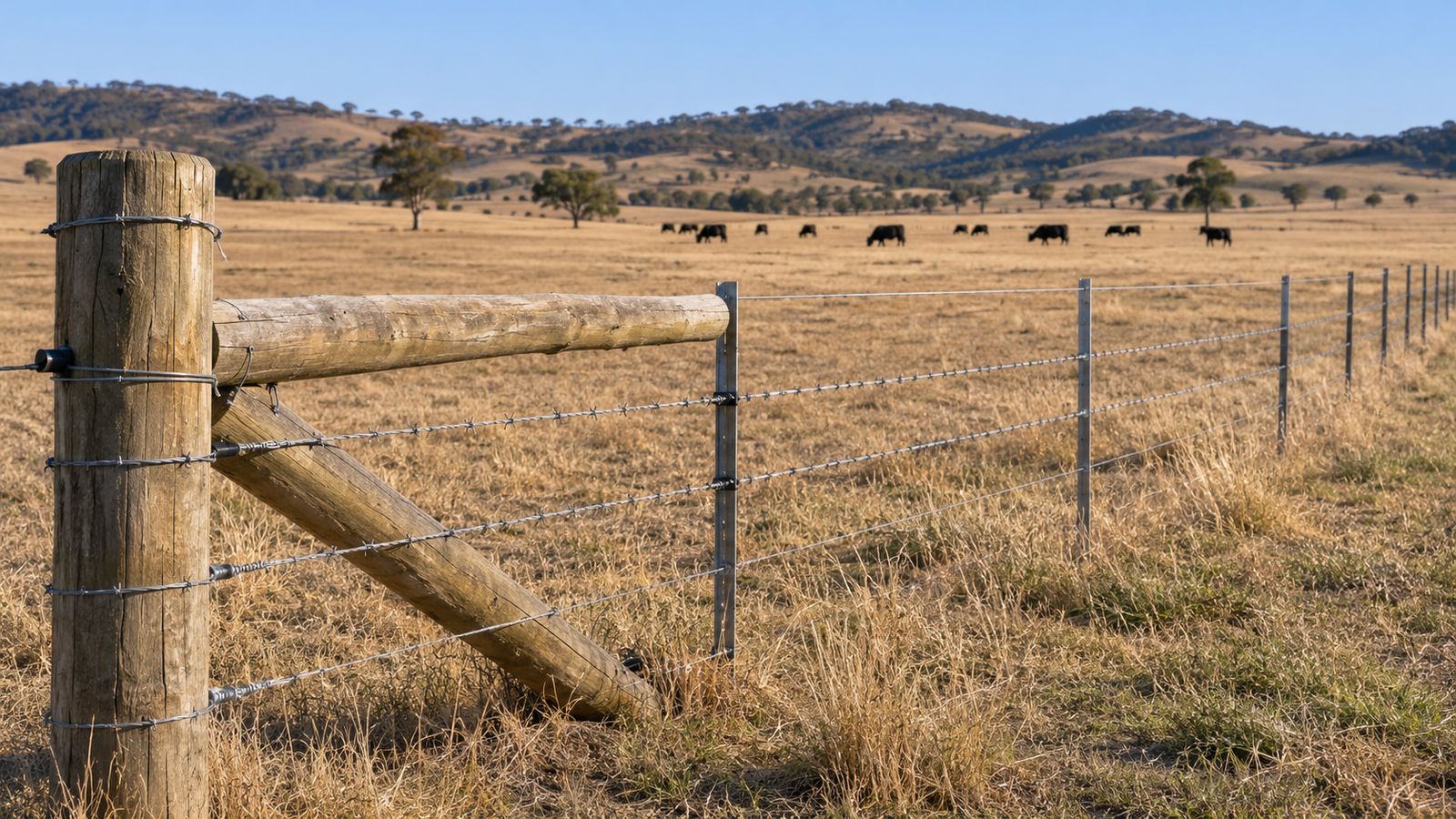
Ground decides how a stock fence is built here more than anything else. On the black soil around Gunnedah and the Liverpool Plains, posts drive easily when the clay is moist and can be very hard when it has dried out. On the granite and shale country to the north and east, the driver hits rock. Contractors who work this district know both and plan around them.
Ask how strainers will be set in your soil, what depth and footing they use, and whether they prefer to build after rain. If a quote assumes clean driving all the way and your line runs over a granite rise, ask what happens when it stops.
Strainers carry the fence
A tensioned fence is only as good as its ends. A timber industry education body grades timber into four durability classes for in-ground use and says treated softwood fence posts should be specified to the H4 treatment level (timber industry guidance). A quote that says "timber strainer" and nothing else leaves out the part that decides how long the end assembly stands, so ask for the species and class, or the treatment level.
Creeks and flood flats
The Peel, Namoi and Mooki and their creeks all flood. Victorian Government guidance for riparian fences in flood-prone areas, an interstate source, suggests putting independent strainers either side of a crossing so a flood takes a short section and leaves the main run standing, and favouring plain wire over netting where water crosses (Victorian riparian fencing guidance). Flood and fire fence repair covers this in more detail.
Dogs and pigs
If wild dogs or feral pigs are a problem, say so before the quote. It changes the netting height, how the bottom is secured and whether electric outriggers are worth adding. Northern Tablelands and North West Local Land Services run a joint wild dog and fox baiting program that in 2026 stretched south to Quirindi (Local Land Services baiting notice). The wild dog and pest fencing guide explains where fencing fits.
Get it quoted
Send the district, the stock, a rough length and a photo along the line through the quote form. If it is a boundary, see farm boundary fencing first. The cost guide explains why ground and wire grade move the figure.
What this page cannot tell you
This page is not a fence specification. It cannot tell you how many wires, what height or what post spacing your paddock needs, because no NSW standard for stock fences turned up in our research. The wire and timber details come from a manufacturer and an industry body as examples. It also cannot predict how long a fence stands on your ground. The contractor who walks your line should specify the fence in writing.
Check the current rules before you rely on this
This page describes the stock fence types contractors commonly quote around Tamworth and what public sources say about netting grades, timber classes and flood crossings. It describes the rules in general terms as they stood in November 2026. Standards, forms, thresholds and fines change.
The authoritative sources are ABS 2021 Census QuickStats: Liverpool Plains (local government area), ABS 2021 Census QuickStats: Walcha (local government area), One manufacturer's hinge joint livestock fence data sheet (manufacturer claims are the manufacturer's), Australian timber industry education body, fencing (durability classes and treatment), Victorian Government, guidelines for riparian fencing in flood-prone areas (2015; Victorian guidance, interstate) and Local Land Services, 1080 aerial and ground baiting program for wild dog and fox control (2026 notice). Where anything here differs from those sources, they are right and we are not.
We are not fencing contractors, builders, regulators or lawyers. For what applies to your fence, ask the contractor which licence or registration they hold for your job, then ask NSW Fair Trading or Building Commission NSW if you are unsure, and ask the council that covers the land.
Accurate at the time of writing, November 2026. Always check the source before relying on it.