What the law asks
Every landholder in NSW has a general biosecurity duty to prevent, eliminate or minimise biosecurity risks so far as is reasonably practicable, and NSW Government guidance says that includes controlling pest animals on your land (NSW Government). The same guidance recommends boundary fencing as one way to help keep pests out. It does not require you to build an exclusion fence.
On wild dogs specifically, the NSW environment department says private and public landowners and managers are required to control them, and lists baiting, trapping, shooting and fencing as the control methods (NSW Environment and Heritage). Fencing is one tool among several.
What is happening around Tamworth
Northern Tablelands and North West Local Land Services run a joint aerial and ground baiting program for wild dogs and foxes, working with National Parks and Forestry. The 2026 notice described a program area from Walgett to Tenterfield and south to Quirindi, with baiting in state forests including around Nundle (Local Land Services baiting notice). That tells you two things: dogs are a serious and widespread problem in this region, and the agencies treat them as a landscape job, not a single-farm one.
| Pest | Damage | Where fencing fits |
|---|---|---|
| Wild dogs | Attacks on sheep, goats and calves | Tall netting with an apron and electric outriggers, ideally as part of a group fence |
| Foxes | Lambs, kids and poultry | Hard to exclude at paddock scale. Coordinated baiting does most of the work. |
| Feral pigs | Pasture and crop damage, lamb losses | Heavy mesh and low hot wires, alongside trapping and shooting |
| Rabbits | Pasture loss, undermined fences | Small mesh with a buried or lapped foot, plus warren control |
A group fence near Walcha
Australian Wool Innovation, an industry body, reported in 2022 on a 44 km predator-proof exclusion fence built through Walcha Council in the Moona Plains and Winterbourne area, joining existing boundary fences into a network of about 111 km. It said the network protects roughly 110,000 hectares of grazing land and about 150 landholders from wild dogs, and was funded by a federal drought pests program (industry body, secondary source).
The lesson is the same as with most pest fencing: it works best when neighbours build it together. A dog fence around one property moves the problem next door and leaves gaps where it meets the neighbour's old netting.
How an exclusion fence differs
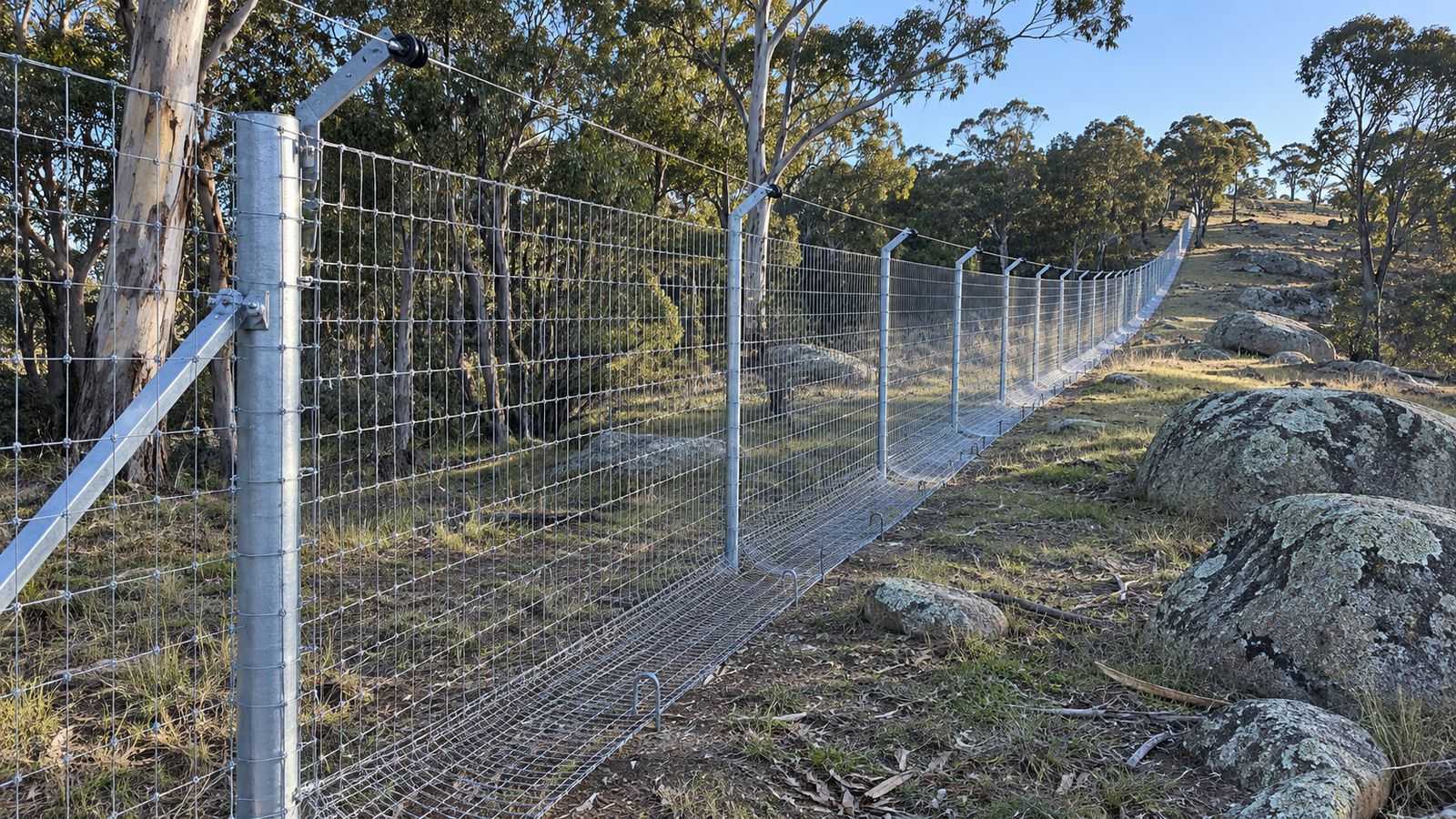
An exclusion fence is designed around what the animal does when it reaches it. Dogs push, dig and sometimes climb. Pigs lift the bottom. Rabbits burrow. So the design answers each: height, an apron or buried foot, hot wires at the top and bottom, and solid strainers at every change in direction. As an illustration only, one Queensland Government rabbit fence design uses fine netting just under a metre high with a separate buried foot (one Queensland Government design). It is a Queensland design, not a NSW rule.
Points to settle with the contractor:
- the animal the fence is for, since a dog fence and a rabbit fence are different,
- how the bottom is secured on rocky or hard ground,
- every gate, grid, creek and road crossing,
- who checks the fence, and how often.
Funding
Government money for pest fencing comes in rounds. One Local Land Services fencing program is listed as completed and was aimed at the Western region (Local Land Services), and the Walcha fence was funded by a drought-era program. We found no open pest fencing grant for this district at the time of writing. Ask Local Land Services what is current before planning around a subsidy.
Where to start
Ring the Local Land Services biosecurity officer for your district first. They know what the neighbours and the local wild dog association are doing and whether a fence is the right move. Then get it quoted through the quote form, describing the pest, length and ground. See electric fencing for outriggers and the Walcha page for the high country.
What an exclusion fence cannot do
An exclusion fence cannot control pests on its own, and it does not meet your biosecurity duty simply by being there. Animals already inside still need dealing with, and one gap at a creek or gate undoes kilometres of netting. This page cannot tell you which design will hold on your ground or whether funding is available. Local Land Services and a contractor who has built dog fences are the people to ask.
Check the current rules before you rely on this
This page describes the general biosecurity duty, the wild dog and fox baiting program across the New England and North West, and where exclusion fencing fits. It describes the rules in general terms as they stood in November 2026. Standards, forms, thresholds and fines change.
The authoritative sources are NSW Government, general biosecurity duty, NSW Environment and Heritage, wild dogs, Local Land Services, 1080 aerial and ground baiting program for wild dog and fox control (2026 notice), Australian Wool Innovation, exclusion fencing in northern NSW (industry body, secondary source), Queensland Government, rabbit fence design (a Queensland design, not a NSW standard) and Local Land Services, Fencing Biosecure Production Zones and Pest Knockout project (completed; Western region). Where anything here differs from those sources, they are right and we are not.
We are not fencing contractors, builders, regulators or lawyers. For what applies to your land, ask the Local Land Services biosecurity officer for your district, and ask the contractor how the fence will be built and checked.
Accurate at the time of writing, November 2026. Always check the source before relying on it.