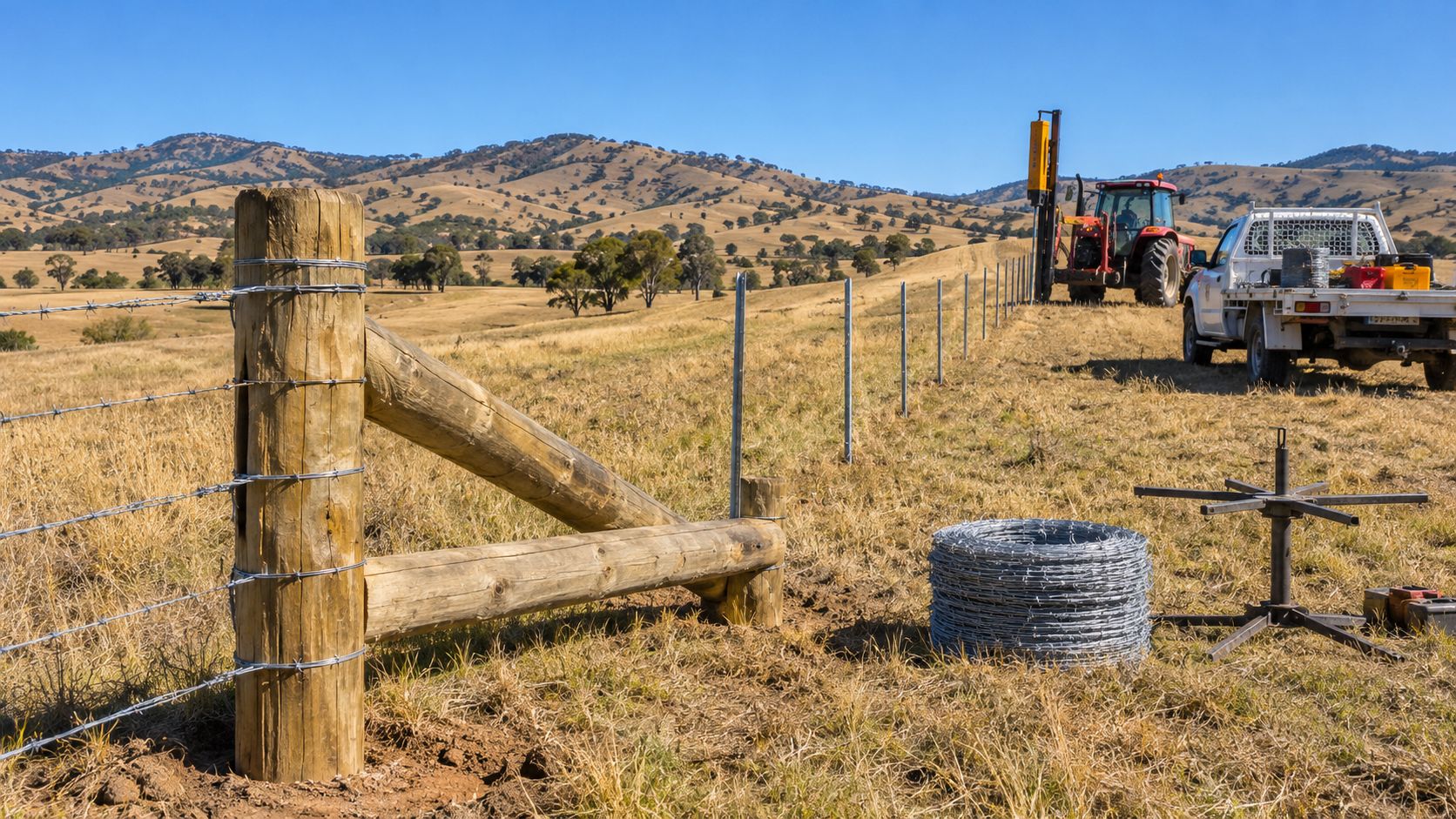
Rural Fencing in Tamworth & the North West
Cattle getting through, a boundary to replace or dogs in the sheep? Tell us the paddock and get a written quote from a local fencing contractor.
Say where the fence runs and what it has to stop
A town, a rough length and one photo along the line are enough to get going.
Request a quote
Cattle country, black soil and dog-proof ridges
Rural fencing around Tamworth covers three quite different kinds of country inside an hour's drive. The Peel and Namoi valleys are cattle country with river flats. West and south, around Gunnedah and the Liverpool Plains, the black soil cropping plains run for kilometres with hardly a bend. East and north, up towards Nundle, Walcha and Barraba, the land climbs into granite hills and timbered ridges where wild dogs are the reason many fences get built.
The climate is hot and fairly dry by tablelands standards. The Bureau of Meteorology's Tamworth Airport station, at 395 m, averages 659 mm of rain, a January maximum of 33.1 degrees and a July minimum of 2.3 degrees (Bureau of Meteorology climate statistics). Summer ground is hard and fire season is long. Winter brings frost but rarely bogs a machine for weeks.
Tamworth itself is a service and processing city. At the 2021 Census the Tamworth Regional council area had 63,070 people, and meat processing was among its three largest employing industries (ABS QuickStats). Much of that meat comes from the paddocks this site is about.
Fencing jobs contractors here take on
Cattle & sheep fencing
Plain, barbed and netting fences for stock on flats and hills.
Read more →Farm boundary fencing
Shared fences with neighbours, and the order to do things in.
Read more →Electric fencing
Hot wires, offsets, dog outriggers and cell grazing.
Read more →Flood & fire damaged fence repair
Getting stock safe and rebuilding smarter.
Read more →Horse & lifestyle block fencing
Rails, mesh and tape for the blocks around town.
Read more →Towns and districts around Tamworth
Each district page explains what is different about fencing there.
Gunnedah
Black soil cropping, cattle and Namoi river flats.
Read more →Quirindi
Liverpool Plains grain and cattle, with Werris Creek and Willow Tree.
Read more →Manilla
Two rivers, cattle flats and grazing hills north of Tamworth.
Read more →Barraba
Granite hill country where beef cattle lead the local jobs.
Read more →Walcha
High tableland sheep and cattle, and wild dog exclusion fences.
Read more →Eight details that speed up a fencing quote
- Town and councilTamworth Regional, Gunnedah, Liverpool Plains or Walcha. It decides who answers approval questions.
- Stock, or what to keep outCattle, sheep, goats, horses, or dogs and pigs. See stock fencing and dog and pest fencing.
- Boundary or internalA boundary usually brings a neighbour into the cost.
- What is over the fenceAnother farm, a lifestyle block, a road, a stock reserve or state forest. See roads and reserves.
- The soilBlack clay, granite, shale or river sand all drive differently.
- AccessCan a ute and a post driver get along the whole line?
- The old fenceComing out or staying in, and who carts it away.
- WhenCalving, joining, a crop going in or a fence already down.
Sharing a boundary fence, step by step
The fence is rarely the hard part of a boundary job. Getting two owners to agree is. Under the Dividing Fences Act 1991 the usual path is short.
| Step | What the sources say |
|---|---|
| Agree it | Settle the line, the fence and the split with your neighbour, and write it down (Legal Aid NSW). |
| Equal shares | Neighbours usually pay half each for a sufficient fence (the Act, version dated 7 December 2024). |
| Extras | Whoever wants more than a sufficient fence pays the extra. |
| Notice | If you cannot agree, send a written notice with the line, the work and the estimated cost. |
| After a month | Either owner may apply to a court or tribunal. Sources differ on which one, so confirm. |
The dividing fences guide goes through it in detail, and farm boundary fencing covers the job itself.
What happens when you send an enquiry
You tell us the job. It goes to a fencing contractor who works your part of the district, who rings you, comes out to walk the line if it suits, and gives you a written quote. From then on it is between you and the contractor. Nothing obliges you to go ahead.
On licences, the only NSW Government fencing page we found talks about fences on residential property boundary lines and says nothing about farms or paddocks. So this site does not say whether a licensing rule covers your job. Ask the contractor which licence or registration applies, and ask NSW Fair Trading or Building Commission NSW if you are unsure. The contractor guide lists what else to ask.
What this site cannot do
This site cannot quote, build or inspect a fence, and it cannot promise a contractor will be free when you need one. It cannot tell you where your boundary is, what your neighbour must pay, or whether council approval or a licence applies. Those questions belong to the contractor, a surveyor, the council, the regulator and, if it comes to a dispute, a court or tribunal. The photographs on this site are illustrative and do not show particular jobs.
Check the current rules before you rely on this
This page describes the country around Tamworth, how a shared rural fence is usually arranged and what the NSW Government page we found says about fencing licences. It describes the rules in general terms as they stood in November 2026. Standards, forms, thresholds and fines change.
The authoritative sources are Bureau of Meteorology, Tamworth Airport AWS climate statistics (station 055325), ABS 2021 Census QuickStats: Tamworth Regional (local government area), Dividing Fences Act 1991 (NSW), in-force version dated 7 December 2024 (check the current version), NSW Government, fencing work (licences and credentials; speaks about fencing on residential property boundary lines) and NSW Planning, fences (exempt and complying development). Where anything here differs from those sources, they are right and we are not.
We are not fencing contractors, builders, regulators or lawyers. For what applies to your fence, ask the contractor which licence or registration they hold for your job, then ask NSW Fair Trading or Building Commission NSW if you are unsure, and ask the council that covers the land.
Accurate at the time of writing, November 2026. Always check the source before relying on it.
Towns and districts covered:
Read these before you compare quotes
What sets the cost
Soil, wire, posts, gates and access.
Read more →Choosing a contractor
Questions to ask and what a quote needs.
Read more →How long fences last
What wears out first and how to slow it.
Read more →Wild dog and pest fencing
Exclusion fences and your biosecurity duty.
Read more →Flood and fire assistance
How disaster help for fences works.
Read more →Approvals and clearing
Council, trees on the line and electric fences.
Read more →What a written fencing quote should list
A quote you can compare names the same things as the next one. Ask every contractor to spell these out.
| Item | What it should say |
|---|---|
| Length | How many metres, and how they were measured. |
| Wire | Plain, barbed or netting, the grade and how many strands. |
| Posts | Steel or timber, size and spacing. |
| Strainers | Material, species or treatment class, and how they are stayed. |
| Gates and grids | How many, how wide, and what they are made of. |
| Crossings | How each creek or gully is fenced and what happens in a flood. |
| Rock and hard ground | What it costs if the driver hits granite or dry clay. |
| Old fence | Whether removal and cartage are included. |
| Service checks | Who checks for powerlines and buried services. |
| Payment and cover | Deposit, stages, and the licence and insurance details the contractor says apply. |
The cost guide explains why each line matters, and the contact page lists what to send.
What landholders around Tamworth ask first
Who pays for a boundary fence between two properties near Tamworth?
In NSW the Dividing Fences Act 1991, in the version we found dated 7 December 2024, says neighbours usually share the cost of a sufficient dividing fence in equal parts, and the owner who wants something better pays the extra. You ask for the share with a written notice describing the line, the work and the estimated cost. Check the current Act before relying on this.
How much does rural fencing cost per metre in Tamworth?
No fair per-metre figure exists for this country. A plain wire cattle fence on the flats at Duri and a netting fence over granite at Bendemeer are priced from different ground, wire and labour. This site gives no rates. Ask for an itemised written quote and compare it item by item with any other you get.
Is this a fencing company?
No. Tamworth Rural Fencing is a referral service. Your enquiry goes to a fencing contractor who works your district, and that contractor measures, quotes, builds and invoices under their own business. They are responsible for any licence or registration that applies. This site gives no prices and signs no contracts.
Which towns around Tamworth are covered?
Tamworth and its villages, the Peel valley out to Nundle, Manilla and Barraba to the north, Gunnedah and Curlewis to the west, Quirindi and Werris Creek on the Liverpool Plains, and Walcha up on the tablelands. Say the nearest town and road when you send an enquiry, because travel shapes which contractor can take it.
What fence do most cattle producers around Tamworth use?
Contractors here commonly quote plain and barbed wire on steel posts with timber strainers for cattle, and add netting or electric wires where sheep, goats or wild dogs are involved. The sources we read set no standard design. Ask the contractor what they propose for your stock and ground, and why.
Is summer a bad time to build a fence near Tamworth?
It is hard work rather than impossible. The Bureau of Meteorology's Tamworth Airport station averages a January maximum above 33 degrees, and dry clay can be slow to drive. Fire danger rules also limit welding and grinding in the warmer months. Many contractors prefer autumn and spring, so book ahead.
Do I need council approval for a farm fence in the Tamworth region?
Often not. NSW planning guidance says many rural fences are exempt development if they are post and wire or post and rail and within a height limit, with exceptions for heritage and some sensitive land. It does not name farm fences, so check with the council that covers the land before work starts.
What should I include in a fencing enquiry?
The town or road, what the fence must hold or keep out, a rough length, whether it is a boundary, and what the ground is like: black soil, rocky hill, creek flat or timber. A photo taken along the line is the most useful single thing you can send. Mention any wild dog or pig problem.
Send a town, a photo and what the fence has to hold
Say the district, the stock or the pest, and roughly how long the fence is. A contractor who works that country picks it up from there.