The road frontage is yours to keep
If your land fronts a public road, keeping your stock off that road is your responsibility. NSW Police say owners must make sure their stock do not stray onto public roads, and that an owner can face a criminal charge if straying stock contribute to a crash (NSW Police). The page does not mention fences, but a sound frontage fence is how most owners meet that duty.
There is no neighbour on the road side to share the cost. On many places around Tamworth the frontage is the one boundary the landholder pays for alone, often beside a busy highway or school bus route.
The road reserve is wider than the road
Country road reserves are often much wider than the gravel or bitumen, and old frontage fences were built wherever was convenient. Another NSW council explains that the council is the road authority across the whole reserve, out to the boundary fences on each side (another council's roadside page). Before replacing a frontage, find out where the title boundary actually is. Fencing onto the reserve can be ordered off. Fencing inside it gives up land you own.
Travelling stock reserves
The North West has a large network of travelling stock reserves, the Crown land corridors and camping reserves set aside for moving and grazing stock. NSW has about two million hectares of them, and Local Land Services manages roughly 30 per cent (NSW Government). Grazing or droving on one needs a permit from Local Land Services, and permits can be suspended or cancelled (TSR users' handbook).
None of the sources we read settles who fences the boundary between a reserve and a farm. The handbook says reserve management includes maintaining fences without saying whose. If you share a boundary with a reserve and the fence is failing, ask Local Land Services before you assume anything.
| Neighbour | Ask | What the sources say |
|---|---|---|
| Public road | The council | The landholder must keep stock off the road. |
| Travelling stock reserve | Local Land Services | Permits are needed to use it. Boundary fencing responsibility is not spelled out. |
| State forest | The forestry agency | Not covered by the sources we read. |
| National park | The parks agency | Not covered by the sources we read. |
| Other Crown land | Crown Lands | A secondary source says public authorities are generally not bound to share fence costs. |
Moving and grazing stock on roads
Droving and roadside grazing are allowed with the right permits. NSW Government guidance says drovers must ensure, as far as practicable, that stock do not endanger people, animals or vehicles, and that stock on a reserve must be fenced off from the road between sunset and sunrise (NSW Government). The same guidance warns that leaving stock unattended in a public place can lead to penalties. Temporary electric fencing is the usual way to hold a mob overnight.
Forests, parks and other public land
Around Nundle, Walcha and Barraba many farms back onto state forest or national park, which is also where dogs and pigs come from. A secondary source says public authorities managing Crown land, parks, reserves and roads are generally not bound by the dividing fence cost-sharing rules, though some contribute voluntarily (State Library NSW). We could not confirm that in the Act. Ask the managing agency, or Crown Lands for other Crown land, what its position is before you get quotes.
Unformed Crown roads, the ones on old parish maps that were never built, are common in the hills. A fence across one may need a permit or enclosure arrangement. Check the title plan before fencing across anything marked as a road.
Grids and entrances
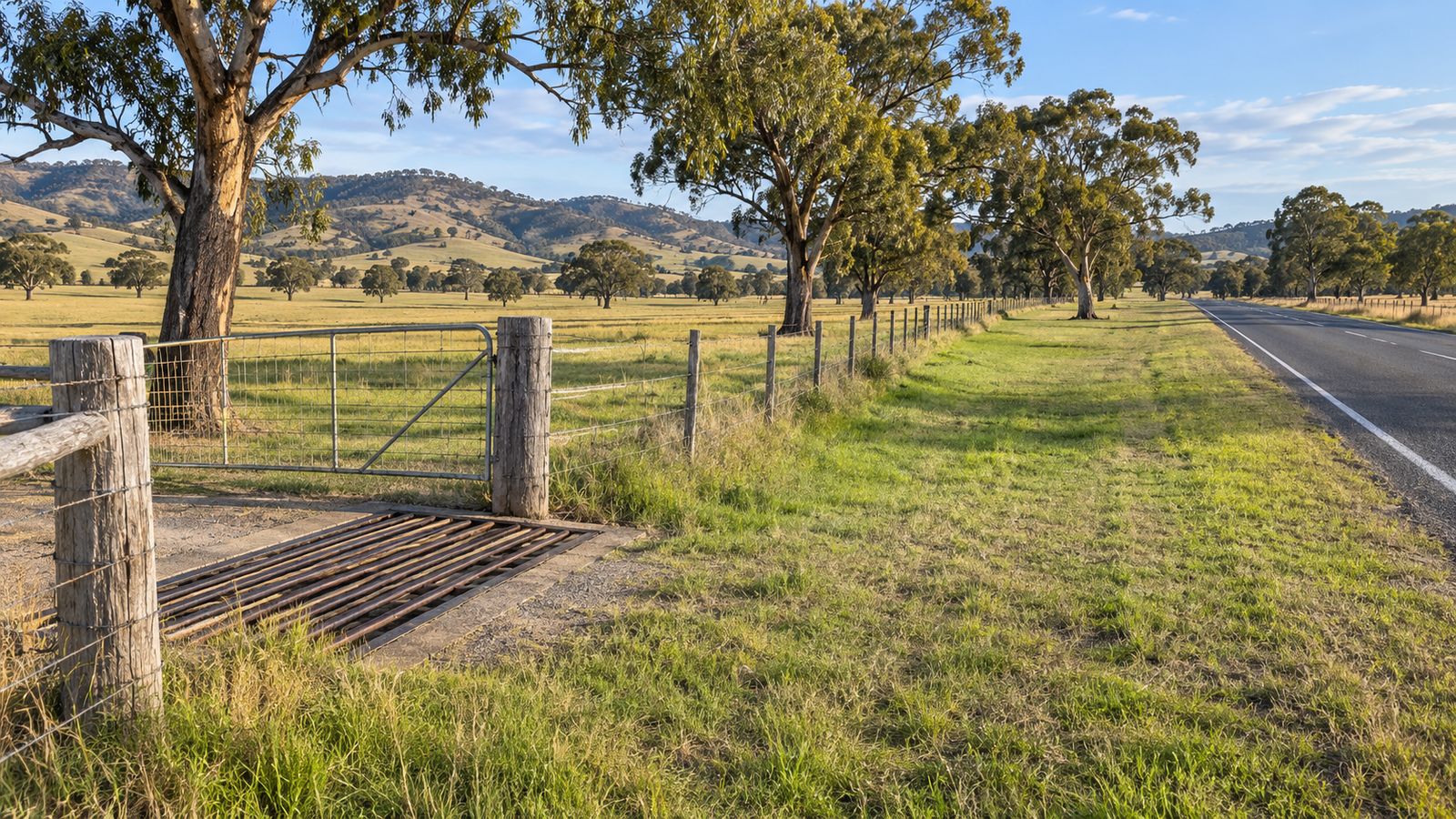
Anything built in the road reserve, such as a new entrance, a grid or a set-back gate, is a matter for the council as road authority. Ask before building. For the fence itself see the approvals guide, and for private boundaries farm boundary fencing. To get a frontage quoted, send the road and length through the quote form.
What this guide cannot settle
It cannot tell you where your road boundary is, whether a public agency will contribute to a fence, or whether a strip of land is a Crown road. It gives no penalty amounts. The sources leave real gaps on public land boundaries and this page says so instead of guessing. A surveyor, the council, Local Land Services, the forestry or parks agency and Crown Lands are the people who can answer for your place.
Check the current rules before you rely on this
This page describes what NSW agencies say about stock on roads, travelling stock reserves and fences next to public land. It describes the rules in general terms as they stood in November 2026. Standards, forms, thresholds and fines change.
The authoritative sources are NSW Police, straying stock on public roads, NSW Government, travelling stock reserves, NSW Government, TSR users handbook, NSW Government, moving livestock on public roads, State Library NSW, dividing fences guide (secondary source) and Junee Shire Council, roadside grazing. Where anything here differs from those sources, they are right and we are not.
We are not fencing contractors, builders, regulators or lawyers. For what applies to your frontage, ask the council as road authority, Local Land Services about travelling stock reserves, and the managing agency or Crown Lands about other public land.
Accurate at the time of writing, November 2026. Always check the source before relying on it.