Why nobody here quotes by the metre over the phone
The price of a rural fence around Tamworth depends on the ground and what you ask for more than on its length. That is why this site gives no rate. A long plain wire boundary on moist black soil near Breeza goes up quickly. The same length of dog netting over granite near Bendemeer, with three gullies and no vehicle access, is a different job entirely.
You can control one thing: making sure every quote you get is for the same fence. Below are the factors that move the number, roughly in order of how much they matter in this district.
Ground first
| Ground | What it does to the job | Ask |
|---|---|---|
| Moist black soil | Drives fast. Strainers need a good footing in heavy clay. | How strainers are set and stayed |
| Dry black soil | Can set hard. Posts go in slowly or need pre-drilling. | Whether they would rather wait for rain |
| Granite and shale hills | The driver stops on rock. Holes are drilled or posts moved. | How rock is charged, per hole or per hour |
| River flats and gullies | Soft spots, crossings and flood sections. | How each crossing is built and priced |
| Timber on the line | Clearing before fencing, within the rules. | Who clears, and whether it is in the price |
Weather plays into the ground. Tamworth averages 659 mm of rain a year at the Bureau of Meteorology's airport station, with hot summers (Bureau of Meteorology). Dry spells make some ground slow to drive. Good rain makes it quick until it is too wet to drive on. Contractors build that into their timing and sometimes their price.
What you ask for
Two quotes for "a cattle fence" can both be fair and still differ a lot, because they quote different things. These are the main choices:
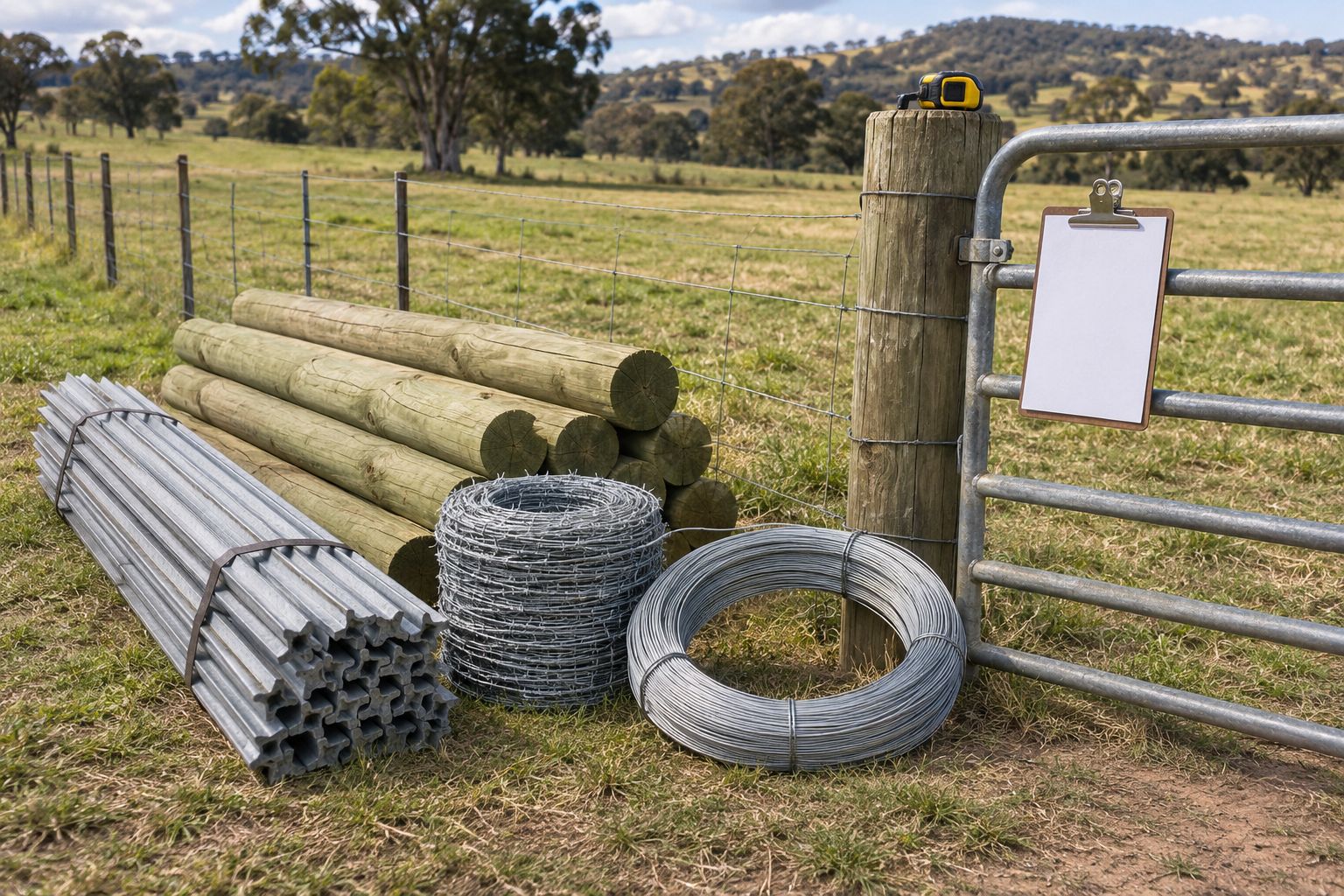
- Wire type and count. Plain, barbed or netting, and how many lines.
- Wire grade. One manufacturer's data sheet lists mild steel, light high tensile and high tensile versions of the same netting. Stronger grades usually cost more.
- Posts. Steel or timber, their size, and how far apart.
- Strainers. End assemblies take the most labour for their length, and every corner and gateway needs them. A timber industry body rates timber in durability classes. Ask which class or treatment is quoted.
- Gates and grids. Each one is a cost of its own.
- Electric add-ons. An energiser, earthing and outriggers are a fixed cost spread over the fence.
Distance and job size
Every quote carries travel. A crew driving from Tamworth to a job past Barraba or out beyond Curlewis loses part of each day on the road. Short jobs a long way out cost more for each length of fence than long jobs close in, because setup, strainers and travel are spread over fewer metres. If you have several small jobs, or a neighbour does, combining them helps everyone.
Timing counts too. Contractors are busiest after rain, after floods or fires, and in autumn and spring. If your job can wait for a quieter spell, say so and ask whether it changes the price.
The old fence and the clean-up
Pulling out old barbed wire wrapped in grass, digging out rotten strainers and carting it away can be a real part of the bill. Ask for removal as a separate line. If the contractor agrees, doing it yourself before they arrive is one of the few ways to save money without cutting the specification. Scrap steel can sometimes offset tip fees.
Sharing with a neighbour
On a boundary, neighbours usually split a sufficient fence equally, and the owner who wants more pays the extra. That only works if the quote separates the base fence from the extras. See farm boundary fencing and the dividing fences guide.
Lining up two quotes
Put them side by side and check each states the measured length, wire type and grade, post material and spacing, strainers and how they are stayed, every gate and grid, every crossing, old fence removal, what happens on rock, who checks for powerlines and buried services, and the payment stages. Where one is silent, ask. The contractor guide has more questions, and you can start a quote on the contact page.
What this guide cannot give you
This guide cannot give you a price, a rate or a ballpark, and anyone who does without seeing the line is guessing. It cannot tell you whether a quote you hold is fair, because that depends on ground only the contractor has walked. The materials details here come from a manufacturer and an industry body and are examples, not requirements. A written, itemised quote is the only number worth planning with.
Check the current rules before you rely on this
This page describes the factors that change the cost of a rural fence around Tamworth and what a written quote should itemise. It describes the rules in general terms as they stood in November 2026. Standards, forms, thresholds and fines change.
The authoritative sources are Bureau of Meteorology, Tamworth Airport AWS climate statistics (station 055325), One manufacturer's hinge joint livestock fence data sheet (manufacturer claims are the manufacturer's), Australian timber industry education body, fencing (durability classes and treatment), NSW Government, native vegetation allowable activities (rural infrastructure, fences) and Dividing Fences Act 1991 (NSW), in-force version dated 7 December 2024 (check the current version). Where anything here differs from those sources, they are right and we are not.
We are not fencing contractors, builders, regulators or lawyers. For what applies to your fence, ask the contractor which licence or registration they hold for your job, then ask NSW Fair Trading or Building Commission NSW if you are unsure, and ask the council that covers the land.
Accurate at the time of writing, November 2026. Always check the source before relying on it.